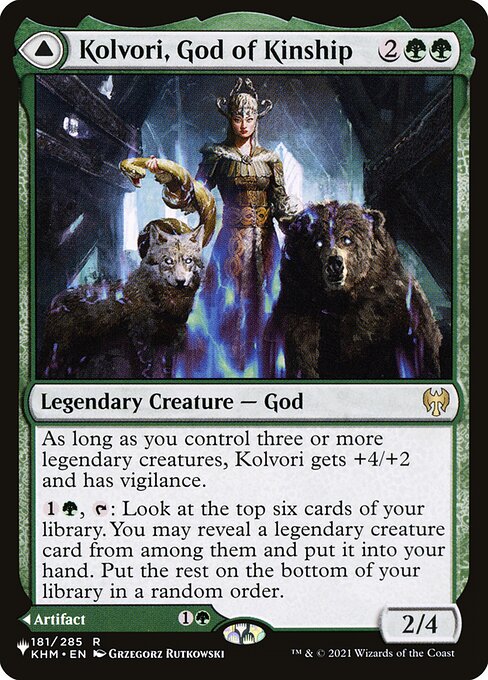
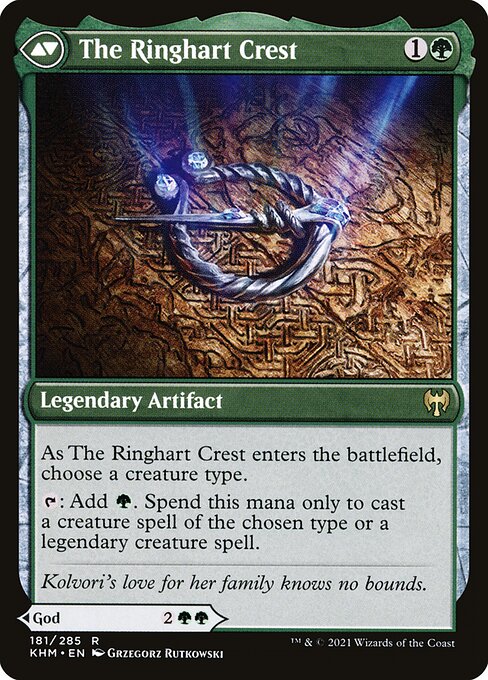

동족애의 신, 콜보리 // 링하르트의 인장
//
전설적 생물 — 신 // 전설적 마법물체
당신이 전설적 생물을 세 개 이상 조종하는 한, 콜보리는 +4/+2를 받고 경계를 가진다.
, : 당신의 서고 맨 위 카드 여섯 장을 본다. 당신은 그중에서 전설적 생물 카드 한 장을 공개하고 당신의 손으로 가져갈 수 있다. 나머지 카드들은 무작위 순서로 당신의 서고 맨 밑에 놓는다.
마법물체
// 링하르트의 인장이 전장에 들어오면서, 생물 유형 한 개를 선택한다.
: 를 추가한다. 이 마나는 전설적 생물 주문 또는 선택한 유형의 생물 주문을 발동하는 데에만 사용할 수 있다.
신
, : 당신의 서고 맨 위 카드 여섯 장을 본다. 당신은 그중에서 전설적 생물 카드 한 장을 공개하고 당신의 손으로 가져갈 수 있다. 나머지 카드들은 무작위 순서로 당신의 서고 맨 밑에 놓는다.
마법물체
// 링하르트의 인장이 전장에 들어오면서, 생물 유형 한 개를 선택한다.
: 를 추가한다. 이 마나는 전설적 생물 주문 또는 선택한 유형의 생물 주문을 발동하는 데에만 사용할 수 있다.
신
2/4









standard
future
historic
gladiator
pioneer
explorer
modern
legacy
pauper
vintage
penny
commander
brawl
historicbrawl
alchemy
paupercommander
duel
oldschool
premodern
Rulings
To determine whether it is legal to play a modal double-faced card, consider only the characteristics of the face you’re playing and ignore the other face’s characteristics.
If The Ringhart Crest is somehow on the battlefield with no choice of creature type, the mana produced by its activated ability can still be spent to cast a legendary creature spell.
If an effect instructs a player to choose a card name, the name of either face may be chosen. If that effect or a linked ability refers to a spell with the chosen name being cast and/or a land with the chosen name being played, it considers only the chosen name, not the other face’s name.
The converted mana cost of a modal double-faced card is based on the characteristics of the face that’s being considered. On the stack and battlefield, consider whichever face is up. In all other zones, consider only the front face. This is different than how the converted mana cost of a transforming double-faced card is determined.
If an effect allows you to play a land or cast a spell from among a group of cards, you may play or cast a modal double-faced card with any face that fits the criteria of that effect.
For The Ringhart Crest’s first ability, you must choose an existing creature type, such as Fungus or Archer. You can’t choose card types (e.g., artifact) or supertypes (e.g., snow).
Because damage remains marked on creatures until the damage is removed as the turn ends, nonlethal damage dealt to Kolvori may become lethal if you controlled three or more legendary creatures and some of them leave the battlefield that turn.
If an effect allows you to play a specific modal double-faced card, you may cast it as a spell or play it as a land, as determined by which face you choose to play. If an effect allows you to cast (rather than “play”) a specific modal double-faced card, you can’t play it as a land.
In the Commander variant, a double-faced card’s color identity is determined by the mana costs and mana symbols in the rules text of both faces combined. If either face has a color indicator or basic land type, those are also considered.
There is a single triangle icon in the top left corner of the front face. There is a double triangle icon in the top left corner of the back face.
If an effect puts a double-faced card onto the battlefield, it enters with its front face up. If that front face can’t be put onto the battlefield, it doesn’t enter the battlefield.
A modal double-faced card can’t be transformed or be put onto the battlefield transformed. Ignore any instruction to transform a modal double-faced card or to put one onto the battlefield transformed.
If The Ringhart Crest is somehow on the battlefield with no choice of creature type, the mana produced by its activated ability can still be spent to cast a legendary creature spell.
If an effect instructs a player to choose a card name, the name of either face may be chosen. If that effect or a linked ability refers to a spell with the chosen name being cast and/or a land with the chosen name being played, it considers only the chosen name, not the other face’s name.
The converted mana cost of a modal double-faced card is based on the characteristics of the face that’s being considered. On the stack and battlefield, consider whichever face is up. In all other zones, consider only the front face. This is different than how the converted mana cost of a transforming double-faced card is determined.
If an effect allows you to play a land or cast a spell from among a group of cards, you may play or cast a modal double-faced card with any face that fits the criteria of that effect.
For The Ringhart Crest’s first ability, you must choose an existing creature type, such as Fungus or Archer. You can’t choose card types (e.g., artifact) or supertypes (e.g., snow).
Because damage remains marked on creatures until the damage is removed as the turn ends, nonlethal damage dealt to Kolvori may become lethal if you controlled three or more legendary creatures and some of them leave the battlefield that turn.
If an effect allows you to play a specific modal double-faced card, you may cast it as a spell or play it as a land, as determined by which face you choose to play. If an effect allows you to cast (rather than “play”) a specific modal double-faced card, you can’t play it as a land.
In the Commander variant, a double-faced card’s color identity is determined by the mana costs and mana symbols in the rules text of both faces combined. If either face has a color indicator or basic land type, those are also considered.
There is a single triangle icon in the top left corner of the front face. There is a double triangle icon in the top left corner of the back face.
If an effect puts a double-faced card onto the battlefield, it enters with its front face up. If that front face can’t be put onto the battlefield, it doesn’t enter the battlefield.
A modal double-faced card can’t be transformed or be put onto the battlefield transformed. Ignore any instruction to transform a modal double-faced card or to put one onto the battlefield transformed.
Rulings
To determine whether it is legal to play a modal double-faced card, consider only the characteristics of the face you’re playing and ignore the other face’s characteristics.
If The Ringhart Crest is somehow on the battlefield with no choice of creature type, the mana produced by its activated ability can still be spent to cast a legendary creature spell.
If an effect instructs a player to choose a card name, the name of either face may be chosen. If that effect or a linked ability refers to a spell with the chosen name being cast and/or a land with the chosen name being played, it considers only the chosen name, not the other face’s name.
The converted mana cost of a modal double-faced card is based on the characteristics of the face that’s being considered. On the stack and battlefield, consider whichever face is up. In all other zones, consider only the front face. This is different than how the converted mana cost of a transforming double-faced card is determined.
If an effect allows you to play a land or cast a spell from among a group of cards, you may play or cast a modal double-faced card with any face that fits the criteria of that effect.
For The Ringhart Crest’s first ability, you must choose an existing creature type, such as Fungus or Archer. You can’t choose card types (e.g., artifact) or supertypes (e.g., snow).
Because damage remains marked on creatures until the damage is removed as the turn ends, nonlethal damage dealt to Kolvori may become lethal if you controlled three or more legendary creatures and some of them leave the battlefield that turn.
If an effect allows you to play a specific modal double-faced card, you may cast it as a spell or play it as a land, as determined by which face you choose to play. If an effect allows you to cast (rather than “play”) a specific modal double-faced card, you can’t play it as a land.
In the Commander variant, a double-faced card’s color identity is determined by the mana costs and mana symbols in the rules text of both faces combined. If either face has a color indicator or basic land type, those are also considered.
There is a single triangle icon in the top left corner of the front face. There is a double triangle icon in the top left corner of the back face.
If an effect puts a double-faced card onto the battlefield, it enters with its front face up. If that front face can’t be put onto the battlefield, it doesn’t enter the battlefield.
A modal double-faced card can’t be transformed or be put onto the battlefield transformed. Ignore any instruction to transform a modal double-faced card or to put one onto the battlefield transformed.
If The Ringhart Crest is somehow on the battlefield with no choice of creature type, the mana produced by its activated ability can still be spent to cast a legendary creature spell.
If an effect instructs a player to choose a card name, the name of either face may be chosen. If that effect or a linked ability refers to a spell with the chosen name being cast and/or a land with the chosen name being played, it considers only the chosen name, not the other face’s name.
The converted mana cost of a modal double-faced card is based on the characteristics of the face that’s being considered. On the stack and battlefield, consider whichever face is up. In all other zones, consider only the front face. This is different than how the converted mana cost of a transforming double-faced card is determined.
If an effect allows you to play a land or cast a spell from among a group of cards, you may play or cast a modal double-faced card with any face that fits the criteria of that effect.
For The Ringhart Crest’s first ability, you must choose an existing creature type, such as Fungus or Archer. You can’t choose card types (e.g., artifact) or supertypes (e.g., snow).
Because damage remains marked on creatures until the damage is removed as the turn ends, nonlethal damage dealt to Kolvori may become lethal if you controlled three or more legendary creatures and some of them leave the battlefield that turn.
If an effect allows you to play a specific modal double-faced card, you may cast it as a spell or play it as a land, as determined by which face you choose to play. If an effect allows you to cast (rather than “play”) a specific modal double-faced card, you can’t play it as a land.
In the Commander variant, a double-faced card’s color identity is determined by the mana costs and mana symbols in the rules text of both faces combined. If either face has a color indicator or basic land type, those are also considered.
There is a single triangle icon in the top left corner of the front face. There is a double triangle icon in the top left corner of the back face.
If an effect puts a double-faced card onto the battlefield, it enters with its front face up. If that front face can’t be put onto the battlefield, it doesn’t enter the battlefield.
A modal double-faced card can’t be transformed or be put onto the battlefield transformed. Ignore any instruction to transform a modal double-faced card or to put one onto the battlefield transformed.
Your collection? Your decks?
Want to manage your collection and/or create decks?