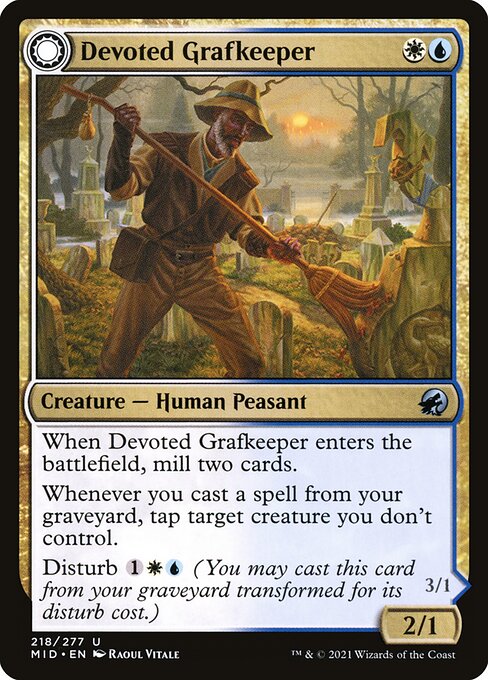
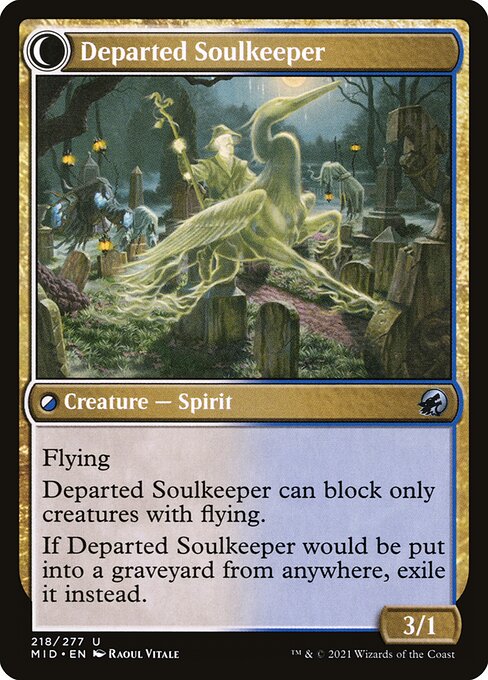

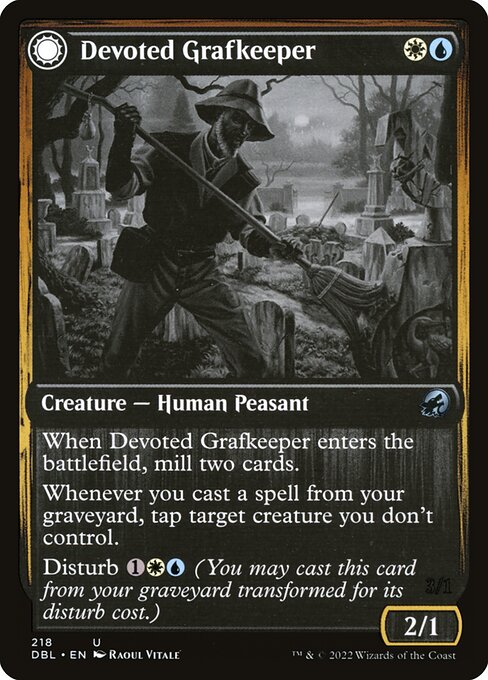
헌신적인 묘지기 // 떠나간 영혼지기
//
생물 — 인간 소작농 // 생물 — 신령
헌신적인 묘지기가 전장에 들어올 때, 카드 두 장을 민다.
당신이 당신의 무덤에서 주문을 발동할 때마다, 당신이 조종하지 않는 생물을 목표로 정한다. 그 생물을 탭한다.
소란 (당신은 이 카드의 소란 비용을 지불해 이 카드를 당신의 무덤에서 변신한 채로 발동할 수 있다.) // 비행
떠나간 영혼지기는 비행을 가진 생물만을 방어할 수 있다.
떠나간 영혼지기가 어디에서든 무덤에 들어가려고 한다면, 대신 떠나간 영혼지기를 추방한다.
당신이 당신의 무덤에서 주문을 발동할 때마다, 당신이 조종하지 않는 생물을 목표로 정한다. 그 생물을 탭한다.
소란 (당신은 이 카드의 소란 비용을 지불해 이 카드를 당신의 무덤에서 변신한 채로 발동할 수 있다.) // 비행
떠나간 영혼지기는 비행을 가진 생물만을 방어할 수 있다.
떠나간 영혼지기가 어디에서든 무덤에 들어가려고 한다면, 대신 떠나간 영혼지기를 추방한다.
2 // 3/1 // 1











standard
future
historic
gladiator
pioneer
modern
legacy
pauper
vintage
penny
commander
brawl
alchemy
paupercommander
duel
oldschool
premodern
Rulings
If you copy a permanent spell cast this way (perhaps with a card like Double Major), the copy becomes a token that's a copy of the card's back face, even though it isn't itself a double-faced card.
To determine the total cost of a spell, start with the mana cost or alternative cost (such as a disturb cost) you're paying, add any cost increases, then apply any cost reductions. The mana value of a spell cast using disturb is determined by the mana cost on the front face of the card, no matter what the total cost to cast the spell was. (This is a special rule that applies only to transforming double faced-cards, including ones with disturb.)
Disturb is found only on the front faces of some double-faced cards.
When you cast a spell using a card's disturb ability, the card is put onto the stack with its back face up. The resulting spell has all the characteristics of that face.
“Disturb [cost]” means “You may cast this card transformed from your graveyard by paying [cost] rather than its mana cost.”
The back face of each card with disturb has an ability that instructs its controller to exile if it would be put into a graveyard from anywhere. This includes going to the graveyard from the stack, so if the spell is countered after you cast it using the disturb ability, it will be put into exile.
A spell cast this way enters the battlefield with its back face up.
To determine the total cost of a spell, start with the mana cost or alternative cost (such as a disturb cost) you're paying, add any cost increases, then apply any cost reductions. The mana value of a spell cast using disturb is determined by the mana cost on the front face of the card, no matter what the total cost to cast the spell was. (This is a special rule that applies only to transforming double faced-cards, including ones with disturb.)
Disturb is found only on the front faces of some double-faced cards.
When you cast a spell using a card's disturb ability, the card is put onto the stack with its back face up. The resulting spell has all the characteristics of that face.
“Disturb [cost]” means “You may cast this card transformed from your graveyard by paying [cost] rather than its mana cost.”
The back face of each card with disturb has an ability that instructs its controller to exile if it would be put into a graveyard from anywhere. This includes going to the graveyard from the stack, so if the spell is countered after you cast it using the disturb ability, it will be put into exile.
A spell cast this way enters the battlefield with its back face up.
Rulings
If you copy a permanent spell cast this way (perhaps with a card like Double Major), the copy becomes a token that's a copy of the card's back face, even though it isn't itself a double-faced card.
To determine the total cost of a spell, start with the mana cost or alternative cost (such as a disturb cost) you're paying, add any cost increases, then apply any cost reductions. The mana value of a spell cast using disturb is determined by the mana cost on the front face of the card, no matter what the total cost to cast the spell was. (This is a special rule that applies only to transforming double faced-cards, including ones with disturb.)
Disturb is found only on the front faces of some double-faced cards.
When you cast a spell using a card's disturb ability, the card is put onto the stack with its back face up. The resulting spell has all the characteristics of that face.
“Disturb [cost]” means “You may cast this card transformed from your graveyard by paying [cost] rather than its mana cost.”
The back face of each card with disturb has an ability that instructs its controller to exile if it would be put into a graveyard from anywhere. This includes going to the graveyard from the stack, so if the spell is countered after you cast it using the disturb ability, it will be put into exile.
A spell cast this way enters the battlefield with its back face up.
To determine the total cost of a spell, start with the mana cost or alternative cost (such as a disturb cost) you're paying, add any cost increases, then apply any cost reductions. The mana value of a spell cast using disturb is determined by the mana cost on the front face of the card, no matter what the total cost to cast the spell was. (This is a special rule that applies only to transforming double faced-cards, including ones with disturb.)
Disturb is found only on the front faces of some double-faced cards.
When you cast a spell using a card's disturb ability, the card is put onto the stack with its back face up. The resulting spell has all the characteristics of that face.
“Disturb [cost]” means “You may cast this card transformed from your graveyard by paying [cost] rather than its mana cost.”
The back face of each card with disturb has an ability that instructs its controller to exile if it would be put into a graveyard from anywhere. This includes going to the graveyard from the stack, so if the spell is countered after you cast it using the disturb ability, it will be put into exile.
A spell cast this way enters the battlefield with its back face up.
Your collection? Your decks?
Want to manage your collection and/or create decks?



 0.14€
0.14€