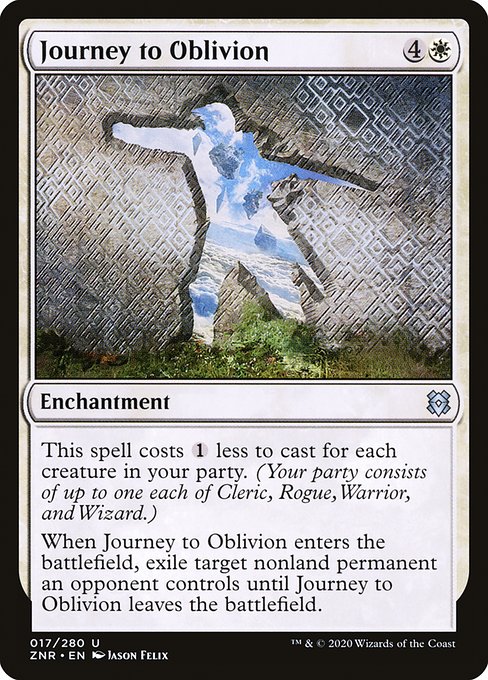

Voyage vers l'oubli
Enchantement
Ce sort coûte de moins à lancer pour chaque créature dans votre groupe. (Votre groupe est composé de jusqu'à un clerc, un gredin, un guerrier et un sorcier.)
Quand le Voyage vers l'oubli arrive sur le champ de bataille, exilez un permanent non-terrain ciblé qu'un adversaire contrôle jusqu'à ce que le Voyage vers l'oubli quitte le champ de bataille.
Quand le Voyage vers l'oubli arrive sur le champ de bataille, exilez un permanent non-terrain ciblé qu'un adversaire contrôle jusqu'à ce que le Voyage vers l'oubli quitte le champ de bataille.











standard
future
historic
gladiator
pioneer
modern
legacy
pauper
vintage
penny
commander
brawl
alchemy
paupercommander
duel
oldschool
premodern
Rulings
If a token is exiled this way, it will cease to exist and won’t return to the battlefield.
An ability referring to the number of creatures in your party gets a number from zero to four. Such abilities never ask which creatures are in your party, and you never have to designate specific creatures as being in your party. You can’t choose to exclude creatures from this count to lower the number.
Several cards have a cost reduction based on the number of creatures in your party. To determine the total cost of a spell, start with the mana cost or alternative cost you’re paying, add any cost increases, then apply any cost reductions. The converted mana cost of the spell is determined only by its mana cost, no matter what the total cost to cast the spell was.
If a creature has more than one party creature type, and there are multiple ways to count that creature that could result in a different number of creatures in your party, the highest such number is used. For example, if you control a Cleric and a Cleric Wizard, the number of creatures in your party is two. You can’t choose to have it be just one by counting the Cleric Wizard first as a Cleric.
Auras attached to the exiled permanent will be put into their owners’ graveyards. Any Equipment will become unattached and remain on the battlefield. Any counters on the exiled permanent will cease to exist. When the card returns to the battlefield, it will be a new object with no connection to the card that was exiled.
If Journey to Oblivion leaves the battlefield before its triggered ability resolves, the target permanent won’t be exiled.
If a spell has a cost reduction based on the number of creatures in your party, no player may attempt to change that number after you begin to cast the spell but before you pay the cost.
To determine “the number of creatures in your party,” check whether you control a Cleric, whether you control a Rogue, whether you control a Warrior, and whether you control a Wizard. The number is the total number of those checks to which you answered yes. Each creature you control can be counted for only one of those checks.
An ability referring to the number of creatures in your party gets a number from zero to four. Such abilities never ask which creatures are in your party, and you never have to designate specific creatures as being in your party. You can’t choose to exclude creatures from this count to lower the number.
Several cards have a cost reduction based on the number of creatures in your party. To determine the total cost of a spell, start with the mana cost or alternative cost you’re paying, add any cost increases, then apply any cost reductions. The converted mana cost of the spell is determined only by its mana cost, no matter what the total cost to cast the spell was.
If a creature has more than one party creature type, and there are multiple ways to count that creature that could result in a different number of creatures in your party, the highest such number is used. For example, if you control a Cleric and a Cleric Wizard, the number of creatures in your party is two. You can’t choose to have it be just one by counting the Cleric Wizard first as a Cleric.
Auras attached to the exiled permanent will be put into their owners’ graveyards. Any Equipment will become unattached and remain on the battlefield. Any counters on the exiled permanent will cease to exist. When the card returns to the battlefield, it will be a new object with no connection to the card that was exiled.
If Journey to Oblivion leaves the battlefield before its triggered ability resolves, the target permanent won’t be exiled.
If a spell has a cost reduction based on the number of creatures in your party, no player may attempt to change that number after you begin to cast the spell but before you pay the cost.
To determine “the number of creatures in your party,” check whether you control a Cleric, whether you control a Rogue, whether you control a Warrior, and whether you control a Wizard. The number is the total number of those checks to which you answered yes. Each creature you control can be counted for only one of those checks.
Rulings
If a token is exiled this way, it will cease to exist and won’t return to the battlefield.
An ability referring to the number of creatures in your party gets a number from zero to four. Such abilities never ask which creatures are in your party, and you never have to designate specific creatures as being in your party. You can’t choose to exclude creatures from this count to lower the number.
Several cards have a cost reduction based on the number of creatures in your party. To determine the total cost of a spell, start with the mana cost or alternative cost you’re paying, add any cost increases, then apply any cost reductions. The converted mana cost of the spell is determined only by its mana cost, no matter what the total cost to cast the spell was.
If a creature has more than one party creature type, and there are multiple ways to count that creature that could result in a different number of creatures in your party, the highest such number is used. For example, if you control a Cleric and a Cleric Wizard, the number of creatures in your party is two. You can’t choose to have it be just one by counting the Cleric Wizard first as a Cleric.
Auras attached to the exiled permanent will be put into their owners’ graveyards. Any Equipment will become unattached and remain on the battlefield. Any counters on the exiled permanent will cease to exist. When the card returns to the battlefield, it will be a new object with no connection to the card that was exiled.
If Journey to Oblivion leaves the battlefield before its triggered ability resolves, the target permanent won’t be exiled.
If a spell has a cost reduction based on the number of creatures in your party, no player may attempt to change that number after you begin to cast the spell but before you pay the cost.
To determine “the number of creatures in your party,” check whether you control a Cleric, whether you control a Rogue, whether you control a Warrior, and whether you control a Wizard. The number is the total number of those checks to which you answered yes. Each creature you control can be counted for only one of those checks.
An ability referring to the number of creatures in your party gets a number from zero to four. Such abilities never ask which creatures are in your party, and you never have to designate specific creatures as being in your party. You can’t choose to exclude creatures from this count to lower the number.
Several cards have a cost reduction based on the number of creatures in your party. To determine the total cost of a spell, start with the mana cost or alternative cost you’re paying, add any cost increases, then apply any cost reductions. The converted mana cost of the spell is determined only by its mana cost, no matter what the total cost to cast the spell was.
If a creature has more than one party creature type, and there are multiple ways to count that creature that could result in a different number of creatures in your party, the highest such number is used. For example, if you control a Cleric and a Cleric Wizard, the number of creatures in your party is two. You can’t choose to have it be just one by counting the Cleric Wizard first as a Cleric.
Auras attached to the exiled permanent will be put into their owners’ graveyards. Any Equipment will become unattached and remain on the battlefield. Any counters on the exiled permanent will cease to exist. When the card returns to the battlefield, it will be a new object with no connection to the card that was exiled.
If Journey to Oblivion leaves the battlefield before its triggered ability resolves, the target permanent won’t be exiled.
If a spell has a cost reduction based on the number of creatures in your party, no player may attempt to change that number after you begin to cast the spell but before you pay the cost.
To determine “the number of creatures in your party,” check whether you control a Cleric, whether you control a Rogue, whether you control a Warrior, and whether you control a Wizard. The number is the total number of those checks to which you answered yes. Each creature you control can be counted for only one of those checks.
Votre collection ? vos decks ?
Envie de gérer votre collection et/ou créer des decks ?