Cliquez pour retourner la carte

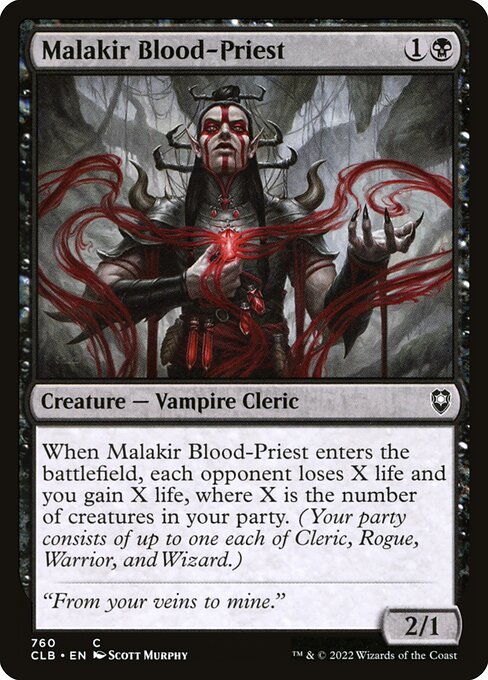
말라키르 혈사제
생물 — 흡혈귀 성직자
말라키르 혈사제가 전장에 들어올 때, 각 상대는 생명 X점을 잃고 당신은 생명 X점을 얻는다. X는 당신의 파티에 있는 생물의 수이다. (당신의 파티에는 성직자, 도적, 전사, 마법사가 각각 최대 한 개씩 포함된다.)
2/1











standard
future
historic
gladiator
pioneer
modern
legacy
pauper
vintage
penny
commander
brawl
alchemy
paupercommander
duel
oldschool
premodern
Rulings
In a Two-Headed Giant game, Malakir Blood-Priest's ability causes the opposing team to lose twice X life and you to gain X life.
If a creature has more than one party creature type, and there are multiple ways to count that creature that could result in a different number of creatures in your party, the highest such number is used. For example, if you control a Cleric and a Cleric Wizard, the number of creatures in your party is two. You can't choose to have it be just one by counting the Cleric Wizard first as a Cleric.
An ability referring to the number of creatures in your party gets a number from zero to four. Such abilities never ask which creatures are in your party, and you never have to designate specific creatures as being in your party. You can't choose to exclude creatures from this count to lower the number.
To determine “the number of creatures in your party,” check whether you control a Cleric, whether you control a Rogue, whether you control a Warrior, and whether you control a Wizard. The number is the total number of those checks to which you answered yes. Each creature you control can be counted for only one of those checks.
If an ability of a creature counts the number of creatures in your party, that number is counted as the ability resolves. If that creature is still on the battlefield when the ability resolves, it'll be counted if appropriate.
If a creature has more than one party creature type, and there are multiple ways to count that creature that could result in a different number of creatures in your party, the highest such number is used. For example, if you control a Cleric and a Cleric Wizard, the number of creatures in your party is two. You can't choose to have it be just one by counting the Cleric Wizard first as a Cleric.
An ability referring to the number of creatures in your party gets a number from zero to four. Such abilities never ask which creatures are in your party, and you never have to designate specific creatures as being in your party. You can't choose to exclude creatures from this count to lower the number.
To determine “the number of creatures in your party,” check whether you control a Cleric, whether you control a Rogue, whether you control a Warrior, and whether you control a Wizard. The number is the total number of those checks to which you answered yes. Each creature you control can be counted for only one of those checks.
If an ability of a creature counts the number of creatures in your party, that number is counted as the ability resolves. If that creature is still on the battlefield when the ability resolves, it'll be counted if appropriate.
Rulings
In a Two-Headed Giant game, Malakir Blood-Priest's ability causes the opposing team to lose twice X life and you to gain X life.
If a creature has more than one party creature type, and there are multiple ways to count that creature that could result in a different number of creatures in your party, the highest such number is used. For example, if you control a Cleric and a Cleric Wizard, the number of creatures in your party is two. You can't choose to have it be just one by counting the Cleric Wizard first as a Cleric.
An ability referring to the number of creatures in your party gets a number from zero to four. Such abilities never ask which creatures are in your party, and you never have to designate specific creatures as being in your party. You can't choose to exclude creatures from this count to lower the number.
To determine “the number of creatures in your party,” check whether you control a Cleric, whether you control a Rogue, whether you control a Warrior, and whether you control a Wizard. The number is the total number of those checks to which you answered yes. Each creature you control can be counted for only one of those checks.
If an ability of a creature counts the number of creatures in your party, that number is counted as the ability resolves. If that creature is still on the battlefield when the ability resolves, it'll be counted if appropriate.
If a creature has more than one party creature type, and there are multiple ways to count that creature that could result in a different number of creatures in your party, the highest such number is used. For example, if you control a Cleric and a Cleric Wizard, the number of creatures in your party is two. You can't choose to have it be just one by counting the Cleric Wizard first as a Cleric.
An ability referring to the number of creatures in your party gets a number from zero to four. Such abilities never ask which creatures are in your party, and you never have to designate specific creatures as being in your party. You can't choose to exclude creatures from this count to lower the number.
To determine “the number of creatures in your party,” check whether you control a Cleric, whether you control a Rogue, whether you control a Warrior, and whether you control a Wizard. The number is the total number of those checks to which you answered yes. Each creature you control can be counted for only one of those checks.
If an ability of a creature counts the number of creatures in your party, that number is counted as the ability resolves. If that creature is still on the battlefield when the ability resolves, it'll be counted if appropriate.
Votre collection ? vos decks ?
Envie de gérer votre collection et/ou créer des decks ?