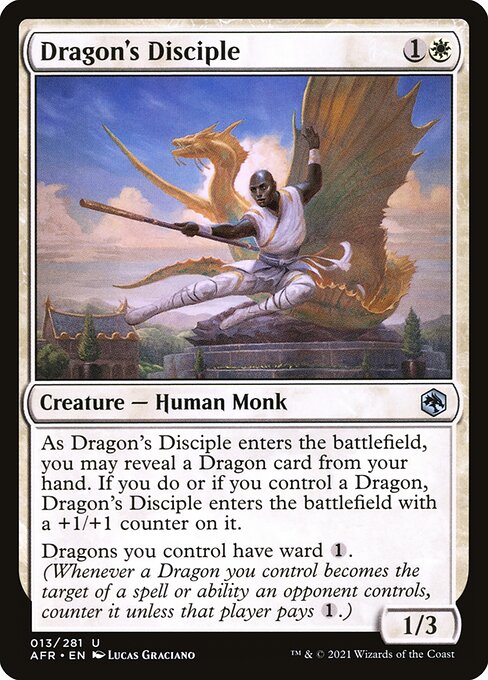

Discípulo del dragón
Criatura — Monje humano
En cuanto el Discípulo del dragón entre al campo de batalla, puedes mostrar una carta de Dragón de tu mano. Si lo haces o si controlas un Dragón, el Discípulo del dragón entra al campo de batalla con un contador +1/+1 sobre él.
Los Dragones que controlas tienen la habilidad de rebatir . (Siempre que un Dragón que controlas sea objetivo de un hechizo o habilidad que controla un oponente, contrarréstalo a menos que ese jugador pague .)
Los Dragones que controlas tienen la habilidad de rebatir . (Siempre que un Dragón que controlas sea objetivo de un hechizo o habilidad que controla un oponente, contrarréstalo a menos que ese jugador pague .)
1/3











standard
future
historic
gladiator
pioneer
modern
legacy
pauper
vintage
penny
commander
brawl
alchemy
paupercommander
duel
oldschool
premodern
Rulings
Revealing a Dragon card happens as Dragon's Disciple resolves. It is not an additional cost for casting the spell.
Players can respond to Dragon's Disciple while it is on the stack, but they cannot respond to the choice of whether or not to reveal a Dragon as it enters the battlefield. Notably, that means they can't remove your Dragon from play to prevent Dragon's Disciple from getting the counter once you've decided not to reveal a Dragon card.
A Dragon card is a card with the creature type Dragon in its type line. Similarly, a creature on the battlefield is a Dragon if it has the Dragon creature type. A card that has “Dragon” in the name (such as Dragon's Disciple) isn't a Dragon card unless it also has the Dragon creature type.
If a player casts a spell that targets multiple permanents their opponent controls with ward, each of those ward abilities will trigger. If that player doesn't pay for all of them, the spell will be countered.
If you choose to reveal a Dragon card from your hand and also control a Dragon, Dragon's Disciple still only gets a single +1/+1 counter.
Players can respond to Dragon's Disciple while it is on the stack, but they cannot respond to the choice of whether or not to reveal a Dragon as it enters the battlefield. Notably, that means they can't remove your Dragon from play to prevent Dragon's Disciple from getting the counter once you've decided not to reveal a Dragon card.
A Dragon card is a card with the creature type Dragon in its type line. Similarly, a creature on the battlefield is a Dragon if it has the Dragon creature type. A card that has “Dragon” in the name (such as Dragon's Disciple) isn't a Dragon card unless it also has the Dragon creature type.
If a player casts a spell that targets multiple permanents their opponent controls with ward, each of those ward abilities will trigger. If that player doesn't pay for all of them, the spell will be countered.
If you choose to reveal a Dragon card from your hand and also control a Dragon, Dragon's Disciple still only gets a single +1/+1 counter.
Rulings
Revealing a Dragon card happens as Dragon's Disciple resolves. It is not an additional cost for casting the spell.
Players can respond to Dragon's Disciple while it is on the stack, but they cannot respond to the choice of whether or not to reveal a Dragon as it enters the battlefield. Notably, that means they can't remove your Dragon from play to prevent Dragon's Disciple from getting the counter once you've decided not to reveal a Dragon card.
A Dragon card is a card with the creature type Dragon in its type line. Similarly, a creature on the battlefield is a Dragon if it has the Dragon creature type. A card that has “Dragon” in the name (such as Dragon's Disciple) isn't a Dragon card unless it also has the Dragon creature type.
If a player casts a spell that targets multiple permanents their opponent controls with ward, each of those ward abilities will trigger. If that player doesn't pay for all of them, the spell will be countered.
If you choose to reveal a Dragon card from your hand and also control a Dragon, Dragon's Disciple still only gets a single +1/+1 counter.
Players can respond to Dragon's Disciple while it is on the stack, but they cannot respond to the choice of whether or not to reveal a Dragon as it enters the battlefield. Notably, that means they can't remove your Dragon from play to prevent Dragon's Disciple from getting the counter once you've decided not to reveal a Dragon card.
A Dragon card is a card with the creature type Dragon in its type line. Similarly, a creature on the battlefield is a Dragon if it has the Dragon creature type. A card that has “Dragon” in the name (such as Dragon's Disciple) isn't a Dragon card unless it also has the Dragon creature type.
If a player casts a spell that targets multiple permanents their opponent controls with ward, each of those ward abilities will trigger. If that player doesn't pay for all of them, the spell will be countered.
If you choose to reveal a Dragon card from your hand and also control a Dragon, Dragon's Disciple still only gets a single +1/+1 counter.
Votre collection ? vos decks ?
Envie de gérer votre collection et/ou créer des decks ?